Healthcare Website SEO Audit Checklist: 15 Essential Checks
Most healthcare SEO audits stop at a technical checklist: page speed, meta tags, and broken links. They miss the real reason patients leave. The content does not answer their questions or establish trust quickly enough to keep them engaged.
I used to think a technical SEO audit and on-page fixes meant a healthcare audit; I was wrong. It took auditing enough healthcare websites to realize the bigger opportunity was almost always sitting in what wasn’t there: the content gaps nobody had mapped, the questions patients were asking that the site never answered.In a YMYL space, that gap costs you more than traffic. It can weaken trust, limit engagement, and make it harder for your content to perform in search.
A healthcare website can look professional, offer useful information, and still struggle to attract qualified organic traffic. The problem isn’t always a lack of content or keywords; it’s technical issues, outdated content, poor search-intent alignment, and missing trust signals that quietly limit performance. A healthcare SEO audit is a structured review of a healthcare website’s technical SEO, content, search intent, trust signals, and conversion paths to identify what may be limiting organic visibility and user engagement.
This healthcare website SEO audit checklist gives you a practical starting point for finding the gaps that may be limiting your organic visibility and the areas worth prioritizing in your SEO and content strategy.
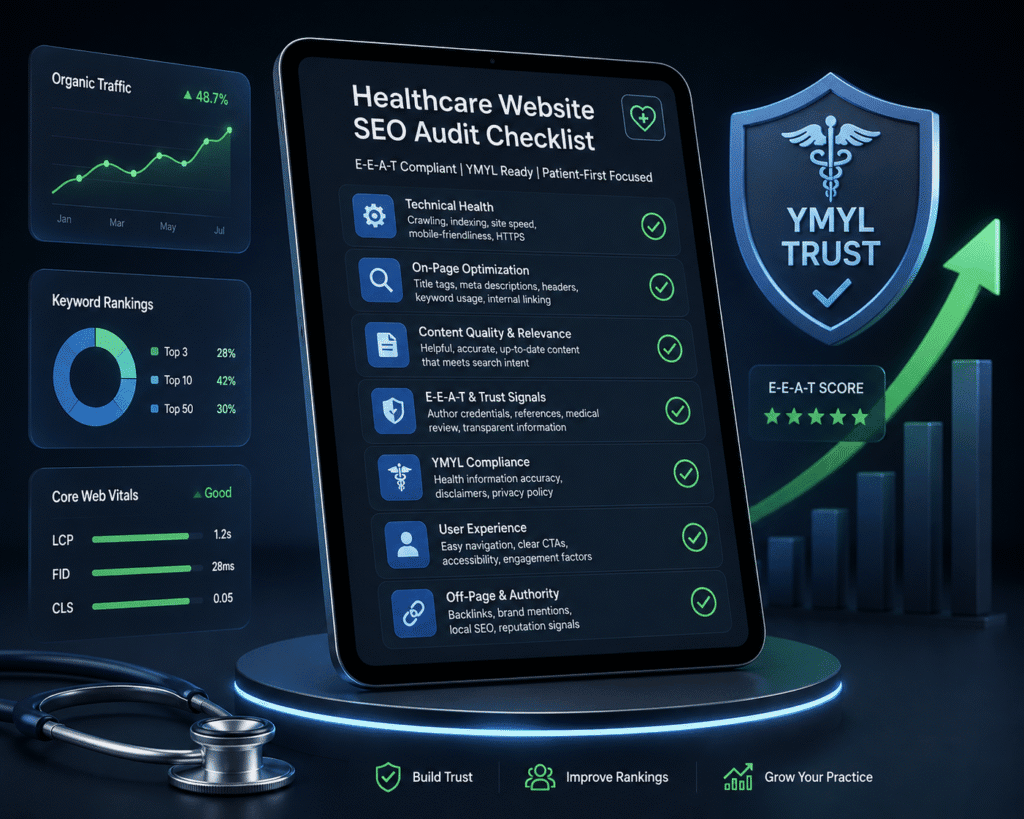
What Does a Healthcare Website SEO Audit Include?
A healthcare website SEO audit typically covers five key areas:
- Technical SEO: Crawlability, indexability, speed, mobile experience
- Content: Keyword targeting, search intent, existing content, content gaps
- Trust: E-E-A-T, medical sourcing, authorship, YMYL signals
- Site structure: Internal linking, navigation, local SEO
- Business impact: CTAs, conversion paths, GSC opportunities, content roadmap
15 Checks for Healthcare Website SEO Audit
A useful healthcare SEO audit connects website performance with what your audience is searching for, what information they need, and how your content supports their journey. Use these 15 checks to find the gaps that deserve attention.
Check Technical Issues That Affect Content Visibility
Start by confirming search engines can access and index the pages you want to rank. You don’t need to turn every audit into a technical implementation project. Flag issues that affect important content and hand off anything that needs specialist support.
Review:
- Crawlability and indexability
- XML sitemap
- Robots.txt
- Broken links
- HTTPS
- Canonical issues
Review Page Speed and User Experience
A slow or difficult-to-use website makes it harder for visitors to engage with your content. Consider it from the visitor’s side: can someone quickly access and understand the information they need?
Review:
- Mobile loading performance
- Core Web Vitals
- Large or unoptimized images
- Unnecessary scripts
- Layout shifts
- Page usability
Audit the Mobile Experience
Healthcare searches often start with a specific question or immediate need. If the site is hard to use on a phone, valuable organic traffic is wasted. Don’t just ask whether the site is “mobile-friendly.” Ask whether the patient journey is easy to complete on mobile.
Check:
- Text readability
- Navigation
- Tap targets
- Forms
- CTAs
- Appointment buttons
- Page layout
Evaluate Healthcare Keyword Targeting
Review whether important pages target searches relevant to the business and its audience. Keyword targeting should follow search intent, not keyword stuffing. The right keyword paired with the wrong content won’t satisfy the searcher.
Look for:
- Primary keywords
- Related search terms
- Long-tail queries
- Service keywords
- Condition-related searches
- Location-based searches
Healthcare SEO Content Audit
A healthcare SEO content audit looks beyond keywords and checks whether existing content is accurate, useful, relevant to search intent, and connected to the website’s broader content strategy.
Review:
- Content accuracy and freshness
- Search-intent alignment
- Missing audience questions
- Thin or repetitive content
- Outdated pages
- Content gaps
- Internal linking
- E-E-A-T and trust signals
- Relevant service and conversion paths
Check Search Intent Alignment
One of the most important parts of a healthcare content audit is asking: does this page satisfy the reason someone searched for the query? For example, someone searching “symptoms of iron deficiency” wants educational information, while “dermatologist near me” has much stronger local and service intent. Review whether the topic, format, depth, and CTA match the searcher’s intent.
Also check whether the page gives the searcher an appropriate next step. Informational content may guide readers toward a related condition or educational resource, while service-focused searches often need a clearer path to a relevant service or appointment.
Conduct a Medical E-E-A-T Audit
Healthcare content should make relevant expertise and accountability clear to readers. A medical E-E-A-T audit shouldn’t mean adding credentials just for SEO. The goal is to help readers understand who created the content and why they can trust it.
Review:
- Author bios
- Relevant professional credentials
- Medical reviewer information where appropriate
- Relevant experience
- Sources and references
- About information
- Contact details
- Website ownership
Review Healthcare YMYL and Trust Signals
Healthcare content deserves particular attention because readers may use it to make health decisions. This review should assess whether content is responsible, trustworthy, and appropriate for its audience.
Look for:
- Unsupported medical claims
- Sensational language
- Misleading statements
- Weak or missing sources
- Outdated information
- Unclear authorship
- Advice presented without appropriate context
Audit Existing Health Content
Don’t assume a website needs more articles before reviewing what it already has. Identify content that’s outdated, thin, repetitive, poorly aligned with search intent, or no longer serving a clear purpose. Sometimes the strongest SEO opportunity isn’t publishing something new; it’s improving existing content.
Evaluate existing pages for:
- Accuracy
- Relevance
- Originality
- Readability
- Freshness
- Appropriate depth
Identify Content Gaps
Look at the website as a complete content ecosystem. This is where an SEO audit becomes a health content strategy. Use search data, audience needs, current content, and business goals to identify what to create, update, combine, or prioritize.
Ask:
- What questions is the audience asking?
- Which important topics are missing?
- Are related questions covered?
- Are informational topics connected to relevant services?
- Are there gaps in the audience journey?
Review On-Page SEO
Review the elements that help search engines and readers understand each page. The goal isn’t to make every page “perfectly optimized.” It’s to make each page clear, relevant, useful, and aligned with its target search intent. Make sure to check;
- SEO title
- H1
- H2 and H3 structure
- Meta description
- URL
- Image alt text
- Keyword placement
- Internal links
Audit Internal Linking
Internal links should help visitors discover relevant information while giving search engines clearer context about how pages relate.
Blog article → condition page → relevant service → provider → appointment
Also review links between related articles, service pages, provider pages, location pages, and supporting resources.
Review Local SEO Content
For clinics and location-based healthcare businesses, check whether the website supports local search intent. The goal is to help people searching for healthcare services in a specific location quickly understand what the practice offers and where it operates.
Review:
- Location pages
- Address and contact information
- Local keywords
- Google Business Profile alignment
- Reviews
- Relevant local information.
Review Trust and Conversion Paths
Organic traffic isn’t the final goal. Your visitors also need a clear path to take the next step. The goal is to connect SEO and content strategy with business outcomes.
Check for:
- Clear CTAs
- Appointment options
- Contact information
- Provider information
- Service explanations
- Relevant credentials
- Easy-to-use forms
Find Pages That Already Have Potential
Use Google Search Console and analytics data to identify pages that may be underperforming. Before creating a new article, ask: could an existing page be improved instead? Updating an existing page can be more strategic than continuously publishing new content.
Look for pages with:
- Impressions but few clicks
- Rankings but little relevant traffic
- Declining organic visibility
- Queries that don’t match the current content
- Organic traffic without meaningful conversions
Turn Audit Findings Into an SEO Content Strategy
A healthcare SEO audit should do more than identify problems. The findings should help shape what your content strategy needs to do next.
Once the audit is complete, group the findings into clear priorities:
Fix now: Technical, accuracy, trust, or content issues that may be limiting performance.
Improve next: Existing pages that could better match search intent, answer audience questions, or strengthen internal linking.
Create: New content needed to address important content gaps or unmet search intent.
Monitor: Areas that need ongoing review, such as content freshness, rankings, and changing audience needs.
This turns the audit into a practical content roadmap rather than a list of recommendations.
For example, if an audit shows that your website has several service pages but very little supporting educational content, the next step may be to build a content cluster around the questions your audience asks before choosing that service.
The audit tells you where the gaps are. Your content strategy determines what to do about them.
A useful process is:
Audit → Prioritize → Fix → Optimize → Create → Measure → Refine
This creates a stronger connection between your website’s current performance and the content you create next.
Common Healthcare SEO Audit Mistakes
A healthcare SEO audit can uncover valuable opportunities, but only if you look beyond basic technical metrics.
Treating Healthcare SEO Like Ordinary SEO
Healthcare content needs greater attention to accuracy, trust, expertise, and YMYL considerations. A keyword-focused approach alone isn’t enough.
Focusing Only on Technical SEO
A technically healthy website can still struggle because its content doesn’t match search intent, answer audience questions, or demonstrate clear expertise.
Treating the Audit as the Final Step
An audit shouldn’t end with a spreadsheet of problems. The findings should become a prioritized SEO and content roadmap that identifies what to fix, update, create, optimize, and measure.
Need a Healthcare SEO & Content Audit?
Not sure whether your healthcare website is attracting the right audience, answering their questions, or turning content into meaningful next steps?
I can review your existing content, identify SEO and content gaps, and help you understand what to prioritize next.
Request a Healthcare SEO & Content Strategy Review