What Should Healthcare Brands Check Before Publishing AI-Generated Content?
AI can speed up many parts of the content process, but publishing AI-generated healthcare content without manual review carries risks. AI-generated content is not always contextually accurate, and even a well-written draft can miss important details.
AI can be useful for initial drafting, organizing ideas, or checking grammar. But the final piece still needs human editorial review. Careful review helps protect accuracy, maintain the standards expected of YMYL content, and build trust with both readers and your brand.
AI and Healthcare Content: What Should Brands Check Before Publishing?
Healthcare content falls within the YMYL (Your Money or Your Life) category, brands need to be especially careful about what they publish. E-E-A-T (Experience, Expertise, Authoritativeness, and Trustworthiness) also plays an important role in demonstrating that content is reliable and created with the appropriate level of care.
Before publishing AI-assisted healthcare content, brands should check a few key things:
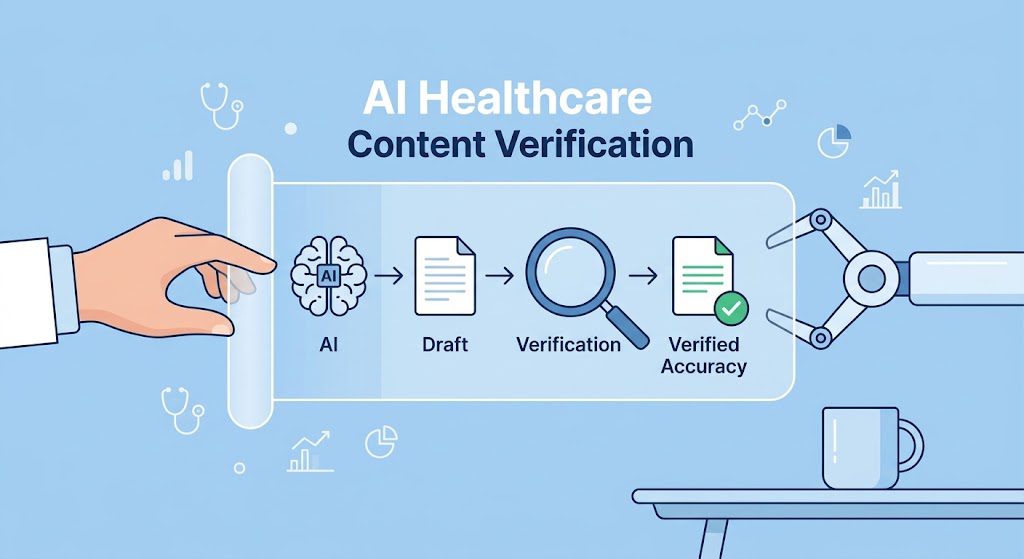
Is the Information in AI-Generated Healthcare Content Accurate?
An AI-generated draft may contain facts that sound reasonable but are incomplete, outdated, or poorly supported.
In healthcare content, that is not something to discover after publication. Important claims should be checked against reliable, current sources. Depending on the topic, that might include government health agencies, professional medical organizations, clinical guidelines, systematic reviews, or peer-reviewed research.
But checking the source is only part of the process. You also need to check whether the source actually supports the wording used in the article.
For example, a study might report an association between two factors. That does not automatically mean one causes the other.
Research may find that a health condition is linked to a particular lifestyle factor. That does not mean the lifestyle factor causes the condition unless the evidence supports a causal relationship.
AI can make these distinctions sound more certain than they really are. Human review is what helps bring the wording back to the evidence.
Is Context Missing From the Healthcare Content?
Accuracy does not mean individual facts are correct. For instance, a statement can be technically accurate and still leave out context that matters to the reader. Healthcare questions rarely exist in isolation. Symptoms can have several possible causes. Treatments may work differently for different people. Recommendations can depend on age, medical history, medications, pregnancy status, or other factors. That context does not mean turning every healthcare article into a medical textbook filled with technical terms. It means including the information a reader needs when leaving it out could change how they understand the claim, its limitations, or what it means for them.
The way a healthcare claim is worded matters too. For example, “There are several possible causes of this symptom” gives the reader a very different impression from “This symptom means you have this condition.” The second statement creates a level of certainty that may not be supported by the evidence. The same applies to treatment claims. Instead of presenting one option as universally appropriate, responsible healthcare content should make clear when treatment decisions depend on individual circumstances, clinical factors, or professional assessment. The goal is not to make the content complicated. It is to make it clear without making the evidence sound more certain than it is.
Does AI Healthcare Content Answer the Real Question?
An article can be medically accurate and still fail the reader because answering the search query is only the beginning. Someone searching “What is insulin resistance?” may want a definition. But once they understand the basic concept, they may immediately ask: What are the symptoms? How is it diagnosed? Does it mean I have diabetes? Can insulin sensitivity improve? What should I ask my doctor?
Those follow-up questions are part of the search journey. This is where I look beyond the primary keyword. The real question is not only, “What did the reader search?” It is, “What are they actually trying to understand, and what will they need to know next?” That is where content gaps often appear.A healthcare brand may have a technically strong article that answers the initial question but leaves the reader with nowhere to go. A stronger content strategy connects the questions:
Audience questions → Search intent → Content gaps → Trust → Content journey
That means looking for the question that comes next, not simply adding more keywords to the existing article.
Does AI-Generated Healthcare Content Match the Evidence?
One of the biggest problems with AI-generated content is not always factual accuracy. It is confidence.AI can produce language that sounds authoritative even when the evidence is limited. That means editors need to ask: does this sentence sound more certain than the evidence allows? Words such as “always,” “proves,” “guarantees,” or “causes” can completely change the meaning of a healthcare claim. Sometimes a small change makes the content much more responsible. Instead of saying, “This symptom means you have X,” the content may need to say, “This symptom can be associated with X, but it can also have other causes.”
That is not unnecessary hedging. It is accurate communication.For YMYL content, trust is built not by sounding certain about everything, but by being clear about what is known, what is uncertain, and where individual circumstances matter.
Does AI Health Content Reflect the Brand?
Even accurate AI-assisted content can feel interchangeable. Many healthcare brands are now publishing content that follows the same basic pattern: definition, symptoms, causes, treatment, conclusion. The information may be correct, but the article does not necessarily sound like the brand or offer anything distinctive. Before publishing, I would ask: does this sound like something this healthcare brand would actually say? Does it reflect the audience’s concerns? Does it explain the topic at the right level? Does it bring a useful perspective, example, expert insight, or patient-focused explanation that a generic AI draft would not?
AI can help with the first version. It should not decide what the brand needs to say. That still requires someone who understands the audience, the search intent, the evidence, and the role the content needs to play. Google’s guidance also emphasizes that content should be helpful, reliable, and created primarily to serve people rather than manipulate search rankings. That distinction matters even more in healthcare.
Healthcare Content Strategy: What Happens After the Reader Finishes?
A useful healthcare article should not feel like a dead end. Once the reader gets an answer, what happens next depends on what they were trying to understand or accomplish. Clear navigation can help guide them to the next relevant piece of content.
For example, someone looking for basic education may need another explanatory article. Someone comparing treatment options may need a more detailed guide, while someone who already understands the problem may be ready to explore a relevant service, product, consultation, or other next step.
Internal links can help create that journey. An article about a health condition could naturally link to related content about symptoms, diagnosis, treatment questions, or prevention. From there, a reader who is further along in their journey might move toward a relevant service page.
The important part is that the next step should make sense. It should help the reader move forward, not simply push them toward a conversion. That is why healthcare content strategy is bigger than individual blog posts. Each article has a role to play within the larger content journey.
Conclusion
AI Can Speed Up Healthcare Content. Human Judgment Still Matters.
AI can be genuinely useful for healthcare content teams. It can help generate ideas, organize information, identify possible gaps, and speed up parts of the writing process. But the strongest AI-assisted healthcare content is not the content that requires the least human input. It is the content where human judgment is still visible. Someone needs to question the evidence. Someone needs to notice the missing context. Someone needs to understand the reader’s next question. And someone needs to decide where the article fits within the brand’s wider content journey. That is the difference between producing more content and creating content that people can actually trust and use.
Search intent before keywords. Clarity before complexity. Trust before traffic.
Need Help Turning AI Drafts Into Better Healthcare Content?
If your healthcare or wellness brand is already using AI but struggling to turn those drafts into accurate, useful, search-focused, and trustworthy content, I can help.
I help healthcare and wellness brands turn audience questions into SEO content that builds visibility and trust. My approach combines search intent, content gaps, healthcare context, and a clear content journey, so each piece has a purpose beyond ranking for a keyword.
Whether you need B2B healthcare content, B2C health blogs, behavioral health content, digital health content, or wellness content, I can help you create content that answers the questions your audience is actually asking and guides them toward the next step.
Want to make your healthcare content more useful, trustworthy, and search-focused? Contact me for a free consultation.
Can AI-generated healthcare content be trusted?
AI is useful for initial drafts, but the final content should be reviewed against current, credible sources and edited for accuracy, context, evidence, and appropriate language before publication.
How can healthcare brands improve AI-generated content?
Start by checking the evidence behind important claims. Then look for missing context, overly confident language, unanswered follow-up questions, and places where the content feels generic. The goal is not simply to edit AI’s wording. It is to add human judgment and make the content genuinely useful to the intended audience.
Is AI-generated healthcare content good for SEO?
AI-assisted content can support an SEO workflow, but using AI does not automatically make content search-friendly. Strong healthcare SEO content still needs to satisfy search intent, provide useful and trustworthy information, address relevant questions, and fit into a meaningful content journey. Search visibility should come from useful content, not from producing content at scale simply to target keywords.