How to Create Healthcare Content That Patients Actually Want to Read
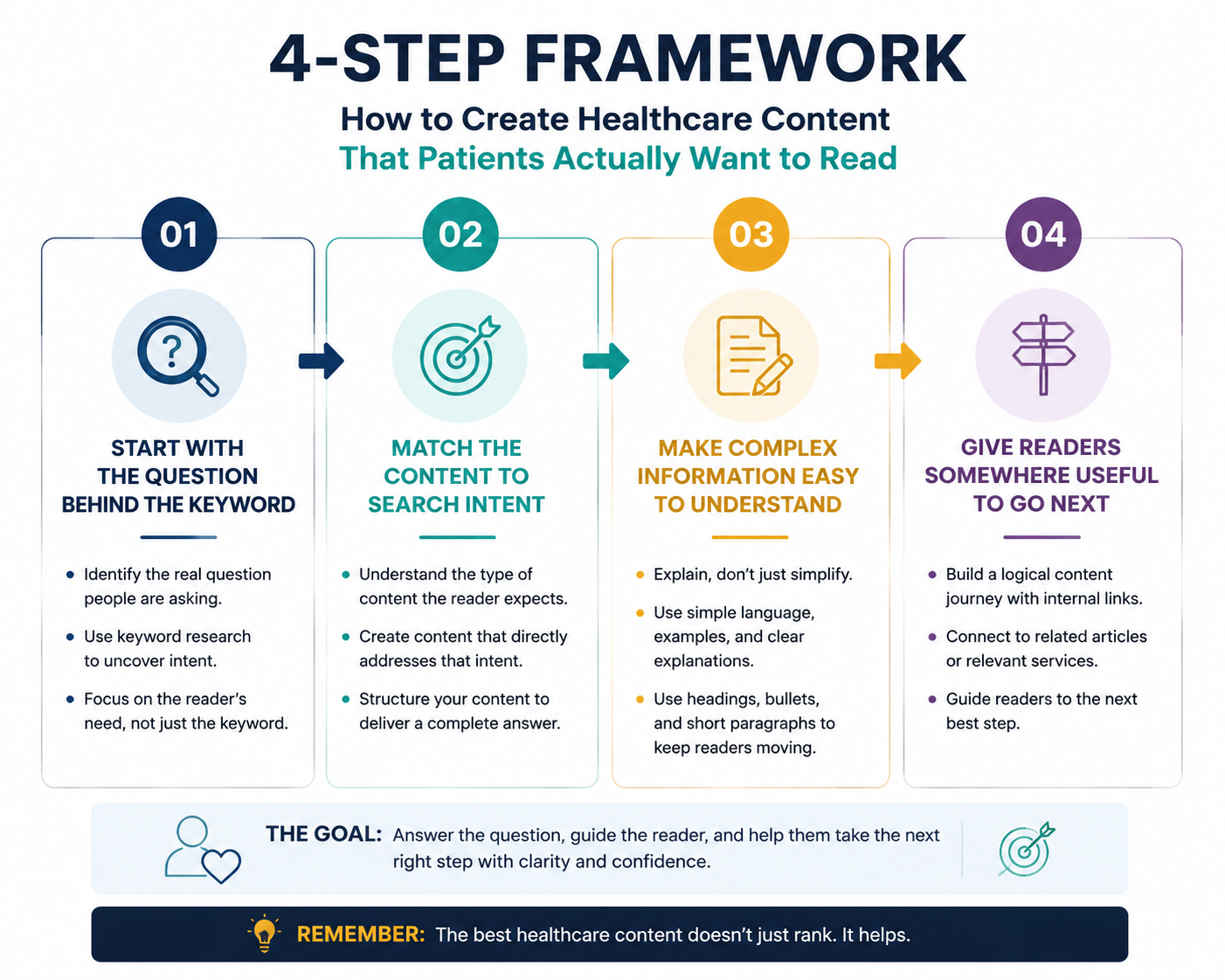
Healthcare content has a visibility problem. A brand can publish consistently, target relevant keywords, and optimize every heading and still create content patients don’t want to read. That’s because ranking isn’t the same as being useful. If you keep asking yourself, “How do I create healthcare content that people actually want to read?”, it’s time to look beyond keywords and start with the reader.
People come to healthcare websites with questions, concerns, uncertainty, and sometimes urgency. They don’t want to read content that feels like it was written for a search engine. They want clear answers and information they can trust.
For healthcare brands, creating content patients want to read starts with understanding
- what people are looking for
- why they’re looking for it,
- what information will genuinely help them.
There are four ways to approach this, starting with helping readers understand what they need to know next.
That’s why the strongest healthcare content doesn’t stop at answering a search query. It anticipates the reader’s next question and guides them toward the information they need.
Start With the Question Behind the Keyword
Keyword research tells you what people are searching. But it doesn’t always tell you what people need. For example, consider a search such as “Why am I always tired?”
The reader may not simply want a definition of fatigue. They could be wondering whether their tiredness is related to sleep, stress, nutrition, a medical condition, or something else. That means the content opportunity is bigger than the keyword itself.
Effective healthcare content starts by understanding the question, concern, or problem behind the search. When you know what the reader is trying to understand, you can create an article that meets their needs, rather than simply matching a search term.
So, the next step is to understand the situation that triggered the reader to search in the first place.
Understand the Searcher's Situation
Before creating a healthcare article, ask:
- What problem is the reader trying to understand?
- What might they be worried about?
- What question are they likely to ask next?
- What information would help them make sense of the topic?
These questions help turn a keyword-targeted article into a genuinely useful resource. The keyword provides the starting point. The reader’s question shapes the content.
Use the Language Your Audience Uses
Once healthcare professionals understand the search intent, they need to write in language that patients can easily understand. Most healthcare brands use clinical terminology that patients don’t understand. Someone might search for “stomach pain after eating” rather than a specific medical term. Another person might search for “why does my heart race at night?” rather than using a clinical description. These everyday phrases can reveal how people think about their health concerns.
Using familiar language can make healthcare content easier to understand and relatable. It also allows you to introduce accurate medical terminology. The goal isn’t to avoid medical language completely. It’s to make sure the reader understands it.
Match the Content to Search Intent
Not every healthcare search requires the same type of content. Someone searching for “symptoms of iron deficiency” is looking for information. Someone searching for “iron deficiency treatment” has a different need. Someone searching for “dermatologist near me” has much stronger local and action-oriented intent.
Treating all three searches as opportunities for the same type of blog post creates a mismatch between the content and the audience. The goal isn’t simply to rank for a keyword. Your content should satisfy the reason behind the search.
Give Readers What They Came For
Before writing, identify the primary intent behind the query. Then structure the content around it. For an informational healthcare article, this might mean:
- Answering the main question early
- Explaining relevant causes or factors
- Addressing common follow-up questions
- Clarifying when professional advice may be appropriate
- Pointing readers toward relevant information elsewhere on the site
Don’t bury the answer underneath a long introduction about why the topic matters. If someone searches for a specific question, make it easy for them to find the answer.
Comprehensive Doesn't Mean Longer
There is a difference between comprehensive content and unnecessarily long content. Adding five paragraphs to repeat the same idea doesn’t make an article more useful.
A strong healthcare article covers the information needed to satisfy the search intent and anticipates relevant follow-up questions. If a topic requires 1,500 words, write 1,500 useful words. If it can be answered properly in 800, don’t stretch it to 1,500 just to hit a word count. Useful content isn’t measured by its length. It’s measured by how well it answers the reader’s need.
Make Complex Health Information Easy to Understand
Healthcare topics can be difficult to explain. Medical terminology, clinical concepts, statistics, and treatment information can quickly turn an otherwise useful article into something that feels inaccessible.
Patients shouldn’t have to understand medical language before they can understand your content. The goal of effective healthcare content is to make complex information clear without removing the accuracy or context readers need.
Explain, Don't Just Simplify
Patient-friendly writing doesn’t mean removing important medical information. It means making that information easier to understand. If a medical term is necessary, explain it when it first appears. If a concept is complicated, break it into smaller sections. If a recommendation has limitations, explain those limitations clearly.
For example, if an article discusses insulin resistance, don’t assume every reader understands the term. Briefly explain what it means before discussing why it matters. This makes the information more accessible without making it inaccurate.
Keep the Reader Moving
Healthcare readers may already feel overwhelmed by the subject they’re researching. Large blocks of dense text can make that worse.
Use:
- Short paragraphs
- Descriptive H2s and H3s
- Bullet points
- Numbered lists
- Clear transitions
- Direct answers
Use headings that tell the reader exactly what they will find in each section. Instead of a vague heading such as “Important Information,” use something specific such as “When Should You See a Doctor About Persistent Headaches?” The second heading provides immediate context and helps readers quickly find the information they need.
Write With a Calm, Human Voice
Healthcare content doesn’t need to sound cold or clinical to be credible. A calm, objective tone can acknowledge that a symptom may be concerning without creating unnecessary fear.
Avoid sensational headlines and dramatic language designed only to generate clicks. The purpose of healthcare content is to inform. That means explaining potential concerns responsibly, avoiding unnecessary alarm, and encouraging appropriate professional guidance when necessary. Clear doesn’t mean less credible. It means more accessible.
Give Readers Somewhere Useful to Go Next
A healthcare article shouldn’t necessarily be the end of the reader’s journey. Once someone has their initial question answered, they may have another question. They may want to explore a related condition, understand a treatment, learn about a healthcare service, or find out what to do next. This is where thoughtful internal linking becomes important.
Build a Logical Content Journey
Building logical internal links helps readers move naturally between relevant pages. For example:
Symptom article → Related condition guide → Treatment information → Relevant service page
Or:
General health topic → Deeper educational article → Healthcare service
The links should be relevant to what the reader has just learned. Don’t add internal links simply because an SEO checklist recommends a certain number.
Instead, ask: “What would this reader logically want to know next?”
That question can lead to much better internal linking decisions and create a more useful content journey.
Connect Informational Content With Commercial Pages Carefully
Informational content can support commercial pages without becoming a sales pitch. A reader researching a healthcare topic may eventually need professional help.
If your website has a relevant service page, make that next step visible when it genuinely fits the reader’s journey. For healthcare brands that need patient-friendly, search-driven content, healthcare content writing services can provide the strategy and writing support needed to turn search intent into useful content.
The informational article should still provide value on its own. The service page can then handle the details about the service, process, and conversion.
The Healthcare Content Journey: Answer → Guide → Action
A useful healthcare article usually has three jobs.
Answer: Give the reader a clear response to the question that brought them there.
Guide: Help them understand the context, related questions, and information they may need next.
Action: Give them an appropriate next step, whether that’s reading another resource, exploring a relevant service, or seeking professional medical advice when appropriate.
The action doesn’t always have to be a conversion. Sometimes the most useful next step is simply helping the reader understand what to ask their healthcare provider. The best healthcare content doesn’t leave the reader wondering what to do with the information they’ve just read.
What Makes Healthcare Content Worth Reading?
Patients don’t need another article that repeats information already available everywhere. They need content that helps them understand something more clearly.
That could mean:
- Answering a question competitors overlook
- Explaining a complicated concept more clearly
- Addressing common misconceptions
- Organizing scattered information into a useful guide
- Providing context around when professional advice may be appropriate
- Anticipating the reader’s next question
This is where content quality wins over content quantity.
A 1,000-word article that answers the reader’s questions can be more useful than a 2,500-word article with repetition.
Use a Simple Pre-Publishing Checklist
Before publishing healthcare content, ask yourself these five questions.
Does It Answer the Actual Search?
If someone searched the target query, would they feel their question was answered? Check whether the article addresses the main search intent early enough and provides the information the reader is actually looking for.
Is It Easy to Understand?
Could a reader without medical training follow the explanation? If not, identify areas where medical terminology, clinical concepts, or recommendations need more context. Clear healthcare content should make complex information easier to understand without sacrificing accuracy.
Is Anything Unnecessary?
Remove sections that exist only to increase word count or repeat the same point. Every paragraph should earn its place. Longer content isn’t automatically better content. What matters is whether each section helps satisfy the reader’s needs.
What Question Will the Reader Ask Next?
Think beyond the initial search. What would the reader naturally want to understand after reading this section? Use that question to identify opportunities for:
- Additional sections
- FAQs
- Related articles
- Internal links
- Relevant healthcare resources
The best healthcare content doesn’t just answer the first question. It helps the reader take the next logical step.
Is the Next Step Useful?
If the reader needs more information or professional support, is there a relevant page they can visit? That could be another educational article, a treatment page, a provider page, or a relevant healthcare service. The next step should feel helpful rather than forced.
Before you publish, make sure the reader isn’t left thinking, “Now what?”
A strong healthcare article answers the question, provides useful context, and gives the reader a clear path forward.
Why This Matters for Healthcare Brands?
For healthcare brands, patient-friendly content isn’t just a publishing task. It’s part of how your website communicates expertise, answers questions, earns organic visibility, and moves readers through their decision-making journey.
That’s why effective healthcare content needs both strong writing and a clear content strategy. The goal isn’t to make every article sell.
The goal is to make every article useful enough that the right reader understands what they’ve found, trusts the information, and knows where to go next.
Make SEO and Patient Experience Work Together
Healthcare content doesn’t become valuable simply because it ranks. It becomes valuable when the person who clicks on it finds something useful. For healthcare brands, that means moving beyond keyword placement and asking better questions:
- What does the reader need?
- Why are they searching for it?
- Can we explain it clearly?
- What should they explore next?
When content answers those questions, SEO and patient experience don’t have to compete. They can work together. A well-structured healthcare article can attract organic visibility while giving readers the clarity they came looking for. It can answer a specific concern, introduce related information, and guide the reader toward an appropriate next step.
That is what makes content useful beyond the search result.
The goal of healthcare SEO isn’t simply to get more people onto a page. It’s to give the right people a reason to stay, understand, and trust what they find.
Need Healthcare Content That Does Both?
If your healthcare brand needs content that patients can actually understand and search engines can actually find, explore my healthcare content writing services.
I create patient-friendly, SEO-driven healthcare content built around search intent, readability, internal linking, and trust.